



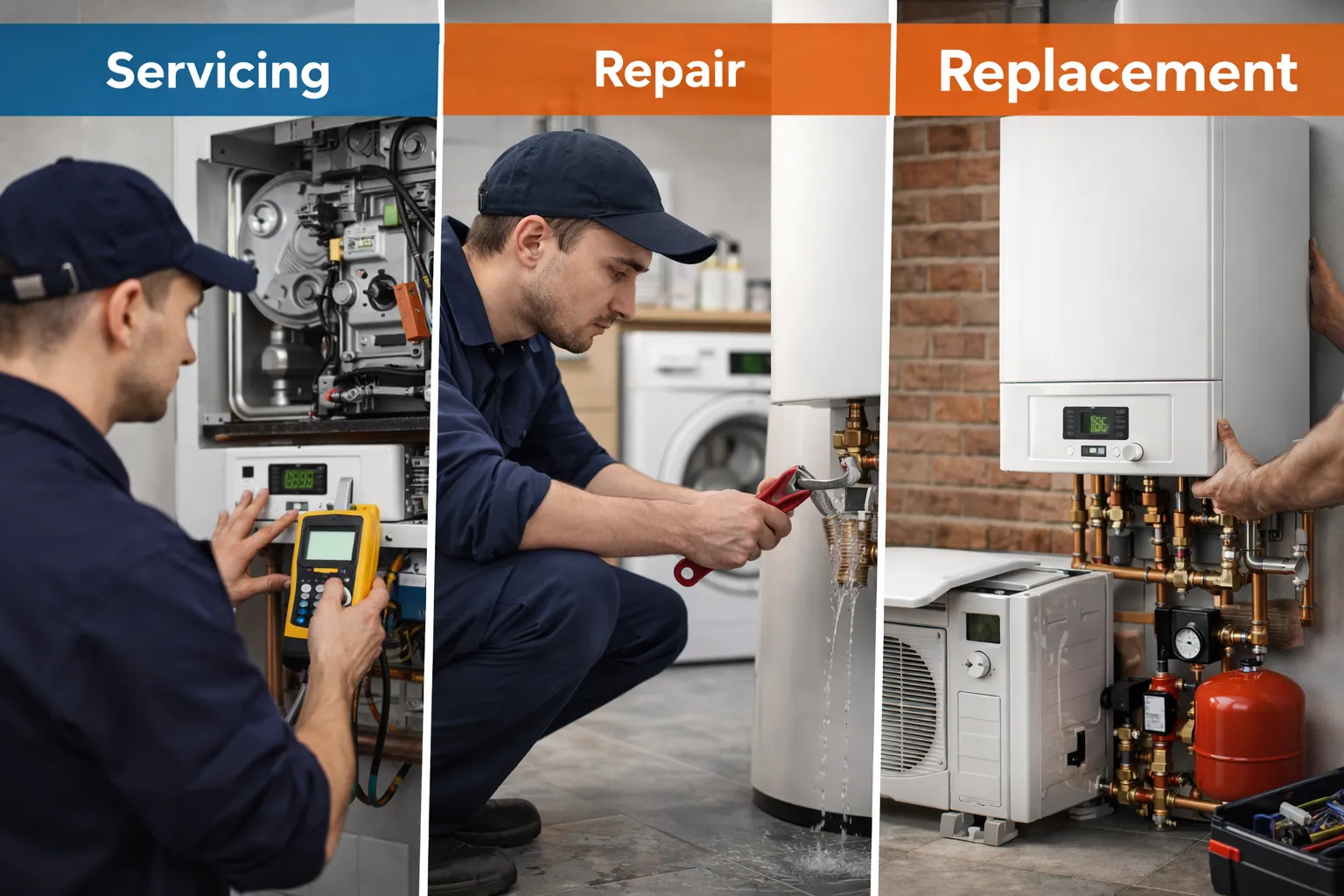
When a boiler starts showing problems, many property owners face the same question:
Should you service it, repair it, or replace it entirely?
Making the wrong decision can lead to higher energy bills, repeated breakdowns, safety risks, or unnecessary costs. This guide explains the differences between boiler servicing, boiler repair, and boiler replacement, helping you understand which option is right for your home or business.
What Is Boiler Servicing?
Boiler servicing is preventive maintenance carried out to ensure your boiler operates safely, efficiently, and reliably.
During a boiler service, an engineer typically:
- Checks key components for wear or faults
- Cleans internal parts where necessary
- Tests safety controls
- Confirms efficient operation
Boiler servicing is usually recommended once a year.
When Boiler Servicing Is the Right Choice
Boiler servicing is suitable if:
- Your boiler is working normally
- There are no active faults
- You want to maintain efficiency and safety
- You want to prevent future breakdowns
Regular servicing helps extend boiler lifespan and reduces the risk of unexpected repairs.
👉 Related service: Boiler Servicing
When Does a Boiler Need Repair?
Boiler repair is required when a specific fault or malfunction occurs. Unlike servicing, repairs address existing problems rather than preventing them.
Common Signs Your Boiler Needs Repair
- No heating or hot water
- Strange noises (banging, whistling, or gurgling)
- Water leaks or pressure drops
- Pilot light or ignition failures
- Error codes on the control panel
Repair vs Temporary Fix
A professional repair restores proper function, whereas repeated temporary fixes often indicate deeper issues. If faults recur frequently, replacement may be more cost-effective.
👉 Related service: Boiler Repairs
When Is Boiler Replacement the Better Option?
Boiler replacement involves removing the existing system and installing a new, modern boiler.
Replacement is often the best option when:
- The boiler is over 10–15 years old
- Repair costs are frequent or increasing
- Energy efficiency has significantly declined
- Spare parts are difficult to source
- The system no longer meets property heating demands
Modern boilers offer improved efficiency, better reliability, and lower running costs, making replacement a long-term investment rather than a short-term fix.
Boiler Servicing vs Repair vs Replacement: Key Differences
Cost Considerations
- Servicing: Lowest cost, planned expense
- Repair: Variable cost depending on fault
- Replacement: Higher upfront cost, lower long-term expense
Energy Efficiency
- Servicing maintains existing efficiency
- Repairs restore lost performance
- Replacement significantly improves efficiency
Reliability
- Servicing reduces breakdown risk
- Repairs fix immediate issues
- Replacement eliminates repeated faults
Safety
- Servicing ensures safe operation
- Repairs address safety-related failures
- Replacement upgrades outdated safety systems
Cost vs Value: Making the Right Boiler Decision
The cheapest option is not always the best value.
A boiler that:
- Breaks down regularly
- Consumes excessive energy
- Requires frequent repairs
often costs more over time than replacing it with a modern, efficient system.
A professional assessment compares:
- Repair frequency
- Efficiency loss
- Remaining lifespan
- Installation suitability
to determine the most cost-effective solution.
Domestic vs Commercial Boiler Decisions
Boiler decisions vary significantly between residential and commercial properties.
Domestic Boiler Considerations
Homeowners usually prioritise:
- Comfort and consistency
- Energy efficiency
- Quiet operation
- Predictable maintenance costs
Domestic boilers often reach replacement age sooner due to daily usage patterns.
Commercial Boiler Considerations
Commercial properties require:
- Higher capacity systems
- Minimal downtime
- Compliance with safety regulations
- Planned maintenance schedules
In commercial settings, replacement is often chosen earlier to avoid operational disruption.
How Often Should a Boiler Be Serviced?
Most boilers should be serviced annually to:
- Maintain manufacturer warranties
- Ensure safety compliance
- Reduce the risk of costly breakdowns
Annual servicing also provides early detection of issues that may later require repair or replacement.
Signs Your Boiler Is Beyond Repair
Replacement may be the better option if:
- Repairs are needed multiple times per year
- Heating performance is inconsistent
- Energy bills continue to rise
- The boiler struggles to meet demand
In these cases, continued repairs often provide diminishing returns.
How a Qualified Boiler Engineer Can Help
A qualified boiler engineer can:
- Assess boiler condition
- Identify safety concerns
- Compare repair vs replacement costs
- Recommend the most suitable solution
Professional advice ensures decisions are based on facts, performance data, and long-term value, not guesswork.
Final Thoughts: Servicing, Repair, or Replacement?
Choosing between boiler servicing, repair, or replacement depends on age, condition, efficiency, and reliability.
- Servicing protects healthy systems
- Repairs resolve isolated faults
- Replacement delivers long-term efficiency and peace of mind
Making the right decision protects your property, reduces costs, and ensures reliable heating when it matters most.
👉 If you’re unsure which option is right for your boiler, contact Brit Heating and Plumbing to arrange an inspection with experienced boiler engineers.